
Not long ago, someone asked me online, “What exactly makes this fine art? Isn’t it just a picture of a pretty place?”
It’s a fair question. We’ve all seen waterfalls, beaches, and mountains photographed countless times. So what makes one photo a postcard and another a fine art print?
For me, the answer lies in intention, interpretation, and craft. There is a difference between recording a scene and creating a piece that resonates long after the shutter is pressed.

More Than a Snapshot
Anyone can stand at a viewpoint and press the shutter. Fine art photography, though, begins long before that click.
It starts with slowing down. I notice the quality of light, the shapes in the landscape, and the emotion a place stirs. When I photograph in the Pacific Northwest, I’m not looking to add another snapshot to the pile. I’m searching for a way to translate the experience of being there into something lasting.
That means asking: What does this place feel like? What do I want the viewer to sense?
A Brief History of Fine Art Photography
The idea of photography as fine art isn’t new. In the late 1800s and early 1900s, photographers like Alfred Stieglitz, Edward Weston, and Ansel Adams argued that photographs could be more than documents. They could stand alongside paintings and sculpture as works of art.
Their approach emphasized vision, composition, and craftsmanship. These are the same principles that still define fine art photography today.
In other words, it’s not the subject that makes it art, but the artist’s interpretation.

The Role of Intention
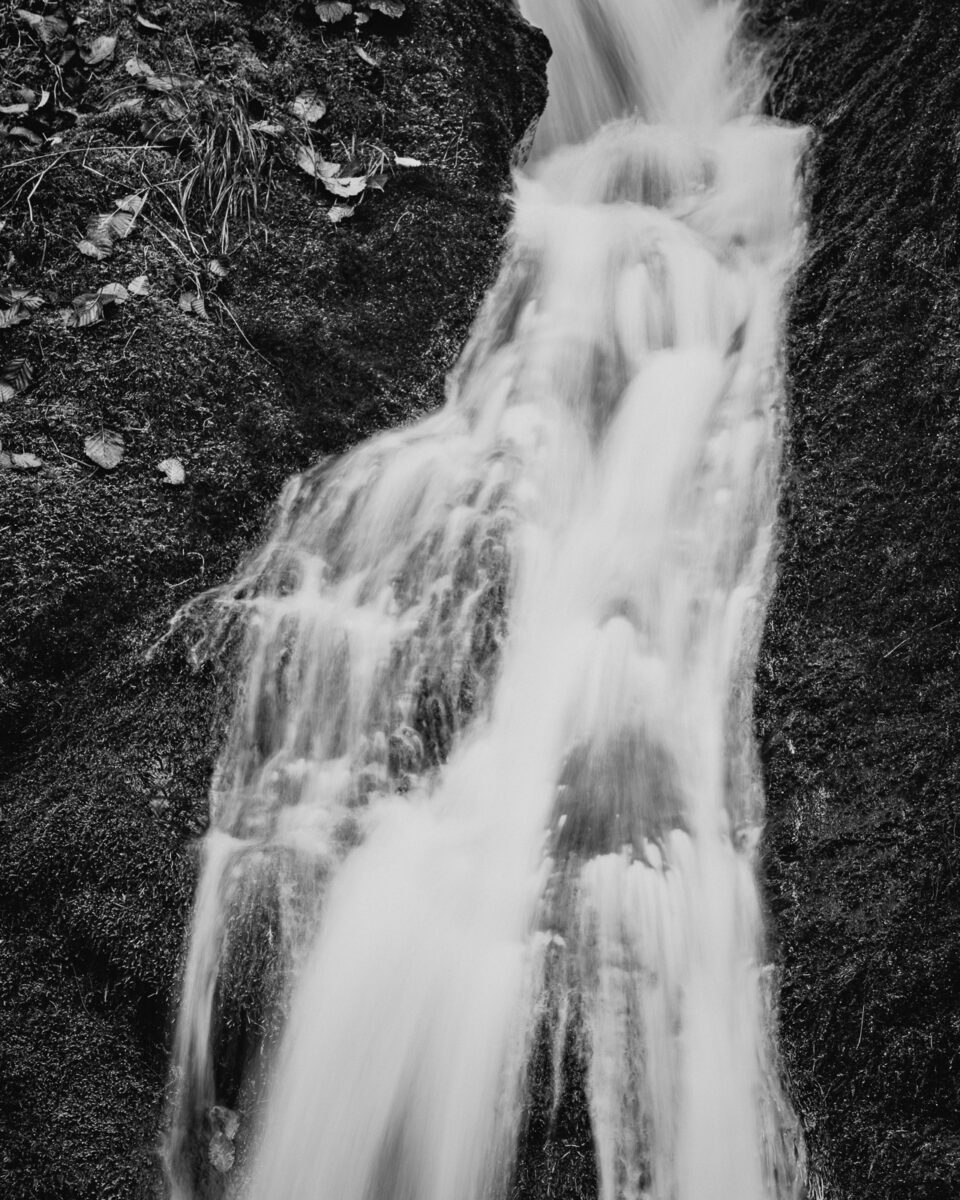
Take Twin Falls in Washington, for example. I camped nearby, spending time listening to the rush of water, feeling the cool spray on my face, and watching how light shifted across moss-covered rock.
My intention wasn’t to capture a postcard view. I wanted to create an image that holds the feeling of that moment: the calm, the weight of water, the timelessness of the forest.
Fine art photography is about putting that sense of presence onto paper.

Interpretation Through Black and White
Color can be beautiful, but it often tells the literal story. Black and white does something different. It removes distraction and emphasizes form, tone, and rhythm.
A forest becomes about shadow and texture. A coastline turns into a study of light and motion.
When I strip away color, I invite the viewer to see deeper. Subtleties of mood, light, and timelessness become more apparent. In this way, the photograph becomes more than representation. It becomes interpretation.

Craft: From Field to Print
The process doesn’t end when the shutter clicks. In fact, that’s just the beginning.
In the film darkroom era, photographers would spend hours dodging and burning prints to match their vision. I follow that tradition digitally, shaping tonal values, refining details, and balancing contrast until the image feels right.
Then comes printing. Every print I offer is professionally produced in the USA by a fine art lab, using museum-quality materials. Each is made to order, so the photograph arrives ready to live on a wall for decades without fading or losing nuance.
Craft is what transforms a fleeting moment into something permanent.

Snapshots vs. Fine Art: A Simple Example
Imagine two people standing at the same viewpoint. One lifts their phone, snaps a quick picture, and moves on. The other lingers, studies the scene, and makes choices about framing, exposure, and interpretation.
The first is a memory aid. The second is an act of creation.
That’s the difference between a snapshot and fine art. One records. The other interprets.

Why Collectors Care
Collectors often tell me they choose black-and-white fine art because it makes them feel something. A sense of calm in a hectic world. A reminder of a place they love. A piece of nature’s stillness brought indoors.
Fine art photography isn’t about decoration alone. It’s about resonance—creating a space that invites reflection, mindfulness, and connection.
That’s why people choose to live with it on their walls.
For me, fine art photography is about slowing down, both as a photographer and as a viewer. It’s about creating a space for quiet, for mindfulness, for connection.
That’s the difference between a picture of a waterfall and a fine art photograph that continues to speak long after it’s made.
If you’d like to see how this philosophy unfolds in my work, I invite you to browse my collections.
Further Explorations:


