
Wildfire smoke hid Mount Rainier the evening before I made this photograph at Corral Pass. By morning, the smoke had cleared. The Rainier View Trail led through burned forest, and up on the ridge, parts of the mountain showed through gaps between the trunks.
I left the trail and walked farther along the open ridge until the trees no longer blocked the view. From there, Mount Rainier was clear in the midsummer light. Between the ridge and the mountain lay a series of forested slopes, each with an outline of its own.
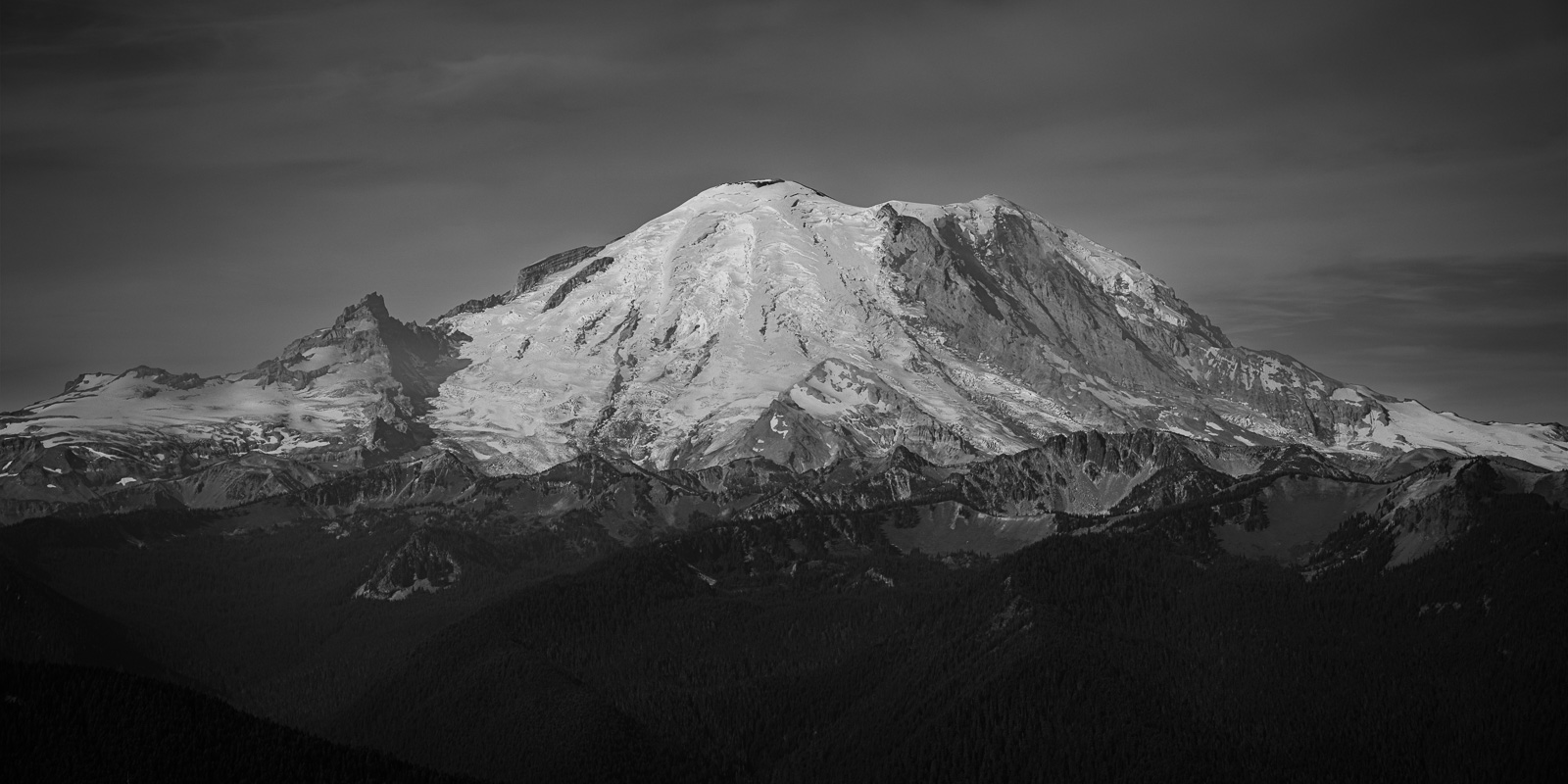
A Natural Panorama
The view was already a panorama. The ridges stretched across the scene on either side of Rainier, and the wide frame gave them room. A tighter composition would have made the mountain larger in the photograph. It also would have left out some of the ground that gave the view its scale.
What held my attention was the quiet weight of that foreground. The nearest ridge takes up a substantial part of the frame. Beyond it, the land falls away in layers. There’s enough room to follow those ridges across the photograph and see how far back the mountain stands.
The View in Black and White
In the finished photograph, I kept the lower landscape deep in tone and the sky subdued. The ridges needed enough separation for their outlines to read and enough weight to hold the foreground together. Against those darker slopes, Rainier emerges naturally. The sky leaves room around the summit, and the mountain’s brightness is enough to draw the eye.
The distance was part of what made Rainier feel so immense. After seeing it in pieces through the trees, there was time to stand on the open ridge and take in the whole view. That’s the feeling I wanted the photograph to hold.
Prints are made to order by a professional lab in the United States.


